
laboratories
Optimize Lab Resources: Outsourcing the Complexity of Inconclusive Data
Variant reinterpretation can transform genetic results into valuable insights for patient care and research.

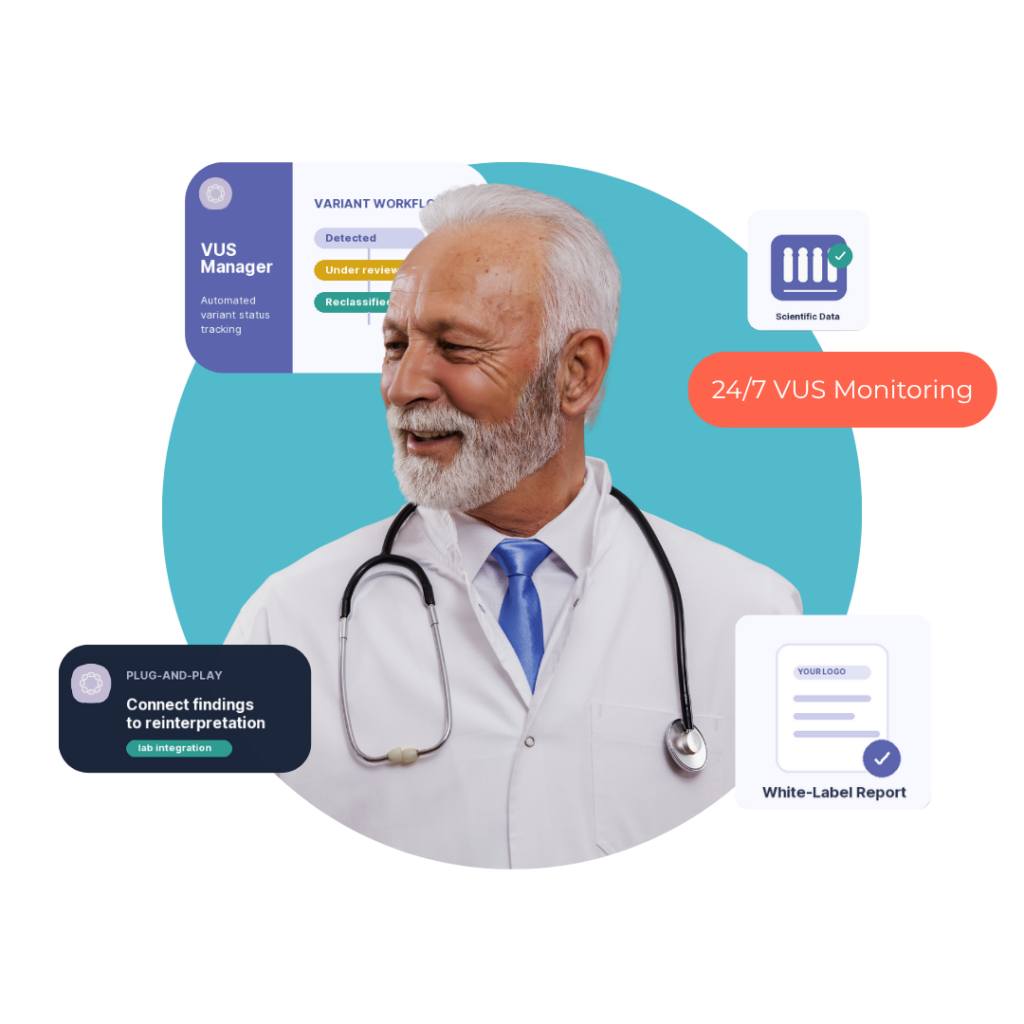
Optimize Lab Operations: Automated VUS Management and Scientific Data Integration
Automated Evidence Surveillance: 24/7 global database monitoring to identify variant re-classifications without manual intervention.
Plug-and-Play Integration: Seamlessly connect your inconclusive findings to our expert-led re-interpretation engine.
White-Label Re-Solution Reports: Deliver semi-annual updates under your own brand, enhancing your laboratory’s long-term clinical value.
how it works
Do you have an uncertain genetic result?
Re-Solve turns uncertainty into clear answers.
1
Collect
Variants of uncertain significance (VUS) will be collect and carefully reviewed before advancing in the workflow.
2
Monitor
A systematic process of monitoring will track variant updates, new evidence, and clinical relevance over time.
3
Resolve
Provide clear, actionable reports summarizing findings and recommended new interpretation of the variant.
4
Support
Genetic counselling will provide updated advice, from variant reinterpretation results and inform family members.
Transforming uncertainty into actionable genomic insights
Re-Solve is built on validated scientific data
Every re-evaluation follows international guidelines, trusted data sources, and continuously updated evidence,—ensuring every decision is rigorous and responsible.

What is a VUS (Variant of Uncertain Significance)?
A VUS is a genetic variant identified through a genetic test for which, at the time of analysis, there is not enough scientific evidence to determine whether it is benign or associated with a clinical condition (pathogenic/likely pathogenic). In other words, it is an “uncertain” result: it does not confirm a diagnosis and cannot support definitive clinical decisions.
Does a VUS mean that I have (or will develop) a disease?
No. A VUS is not a conclusive result. It simply means that, at the time it was identified, the scientific community did not have enough evidence to determine its clinical significance.
Why can the classification of a VUS change over time?
Because genetics is a continuously evolving field: new studies are published, databases are updated, new clinical cases emerge, and biological mechanisms become clearer. As a result, what is uncertain today may become clearer in the future.
What does “variant re-evaluation” mean?
It involves systematically assessing whether new evidence has emerged since your report was issued that could change the clinical interpretation of the variant. Rather than a one-time process, it is most valuable when performed continuously and with full traceability.
What is the difference between “re-evaluation” and “reanalysis”?
Reanalysis typically involves reprocessing genetic data using updated pipelines and/or expanding the analysis, for example to additional genes, regions, or approaches. This usually applies to whole exome sequencing (WES) or whole genome sequencing (WGS) data. Re-evaluation, on the other hand, focuses on an already identified variant and answers a specific question: “Is there now enough scientific evidence to interpret this variant better than before?” RE-SOLVE is primarily designed for this second need.
What happens if my VUS is reclassified?
If the classification changes, for example to “pathogenic” or “benign”, the update is documented and communicated promptly, so that your clinician can assess its potential implications for you and, if relevant, your family members.
Does RE-SOLVE provide a diagnosis?
No. RE-SOLVE does not replace your doctor or clinical geneticist. It provides an evidence-based interpretative update that must always be considered in the context of your clinical history and any additional tests.
If my variant never changes, is it still worth monitoring?
Yes. Monitoring ensures that your variant is not “forgotten”. It helps prevent scientific progress from remaining disconnected from your specific case.
What does RE-SOLVE provide to clinicians in practice?
Traceable updates on the interpretation of previously identified VUS, based on new evidence and a structured re-evaluation process.
Is this a bioinformatics reanalysis?
No. The core approach is evidence-driven re-evaluation of an already identified variant, not full reprocessing of raw genetic data.
Does RE-SOLVE replace the laboratory?
No. The laboratory generates the data and the initial interpretation; RE-SOLVE adds a structured follow-up layer over time, reducing the risk that interpretations become outdated without being updated.
What is the operational advantage for laboratories?
It reduces the burden of manual and intermittent re-evaluation by turning it into a more continuous, documented, and manageable process (also valuable for compliance and traceability).
Why is variant re-evaluation relevant for pharma and research?
Because historical genomic data can quickly lose value: if a variant changes meaning and no one updates it, both clinical relevance and real-world evidence are lost. A structured follow-up system improves the quality, consistency, and relevance of cohorts over time.
A VUS is a genetic variant identified through a genetic test for which, at the time of analysis, there is not enough scientific evidence to determine whether it is benign or associated with a clinical condition (pathogenic/likely pathogenic). In other words, it is an “uncertain” result: it does not confirm a diagnosis and cannot support definitive clinical decisions.
No. A VUS is not a conclusive result. It simply means that, at the time it was identified, the scientific community did not have enough evidence to determine its clinical significance.
Because genetics is a continuously evolving field: new studies are published, databases are updated, new clinical cases emerge, and biological mechanisms become clearer. As a result, what is uncertain today may become clearer in the future.
It involves systematically assessing whether new evidence has emerged since your report was issued that could change the clinical interpretation of the variant. Rather than a one-time process, it is most valuable when performed continuously and with full traceability.
Reanalysis typically involves reprocessing genetic data using updated pipelines and/or expanding the analysis (e.g., to additional genes, regions, or approaches). Usually applicable to whole exome sequencing (WES) or whole genome sequencing (WGS) data.
Re-evaluation, on the other hand, focuses on an already identified variant and answers a specific question: “Is there now enough scientific evidence to interpret this variant better than before?”RE-SOLVE is primarily designed for this second need.
If the classification changes (for example, to “pathogenic” or “benign”), the update is documented and communicated promptly, so that your clinician can assess its potential implications for you and, if relevant, your family members.
No. RE-SOLVE does not replace your doctor or clinical geneticist. It provides an evidence-based interpretative update that must always be considered in the context of your clinical history and any additional tests.
Yes. Monitoring ensures that your variant is not “forgotten.” It helps prevent scientific progress from remaining disconnected from your specific case.
Traceable updates on the interpretation of previously identified VUS, based on new evidence and a structured re-evaluation process.
No. The core approach is evidence-driven re-evaluation of an already identified variant, not full reprocessing of raw genetic data.
No. The laboratory generates the data and the initial interpretation; RE-SOLVE adds a structured follow-up layer over time, reducing the risk that interpretations become outdated without being updated.
It reduces the burden of manual and intermittent re-evaluation by turning it into a more continuous, documented, and manageable process (also valuable for compliance and traceability).
Because historical genomic data can quickly lose value: if a variant changes meaning and no one updates it, both clinical relevance and real-world evidence are lost. A structured follow-up system improves the quality, consistency, and relevance of cohorts over time.
Who Resolve can Assist
A new approach to managing inconclusive genetic test results

Patients
Discovery the opportunities to reinterpret your inconclusive genetic testing results.

Physicians
Receive guidance on patient care from clear genetic results.

Partners
Drive innovation. Improve patient outcomes.